
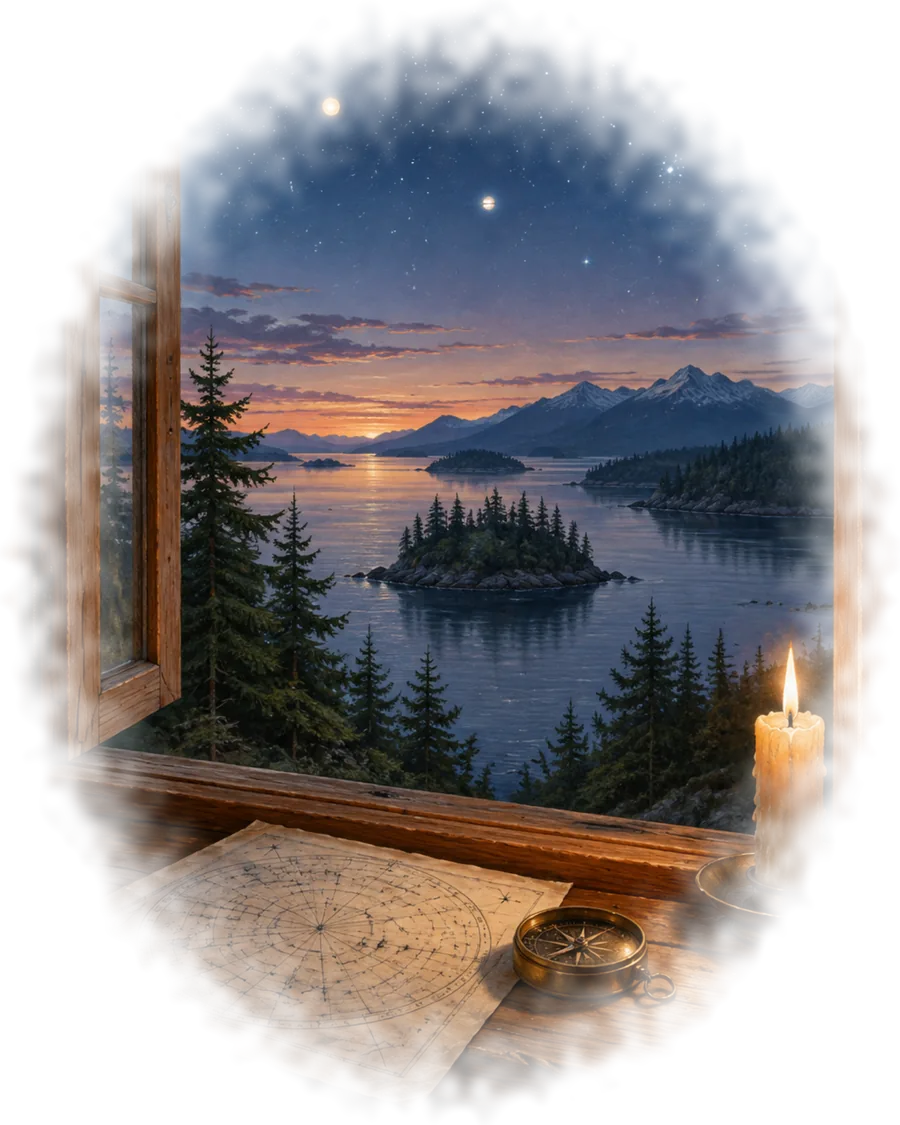
Vedic astrology is a highly structured mirror. Your personal chart is a universal map of archetypes and timing: it shows which parts of you are likely to take the stage, and when. A forecast doesn’t make the rain. It tells you to bring a coat.
Why it’s on the front door
I’ve studied Vedic astrology since 2009, and it runs under almost everything at Ecotone: your planetary chapter in the free Assessment, the good days in Good Times, the personal books, the PHASE SHIFT letters. I don’t hide it, and I don’t ask you to believe in it. I ask you to look into it the way you’d look into a mirror, and notice what looks back.
What follows is how I use it, in two parts. The first is psychology: astrology as a projection tool and a map of the parts of you. The second is physics: a theory of how the sky might reach us at all.
A language of symbols
Psychologists have long used open-ended images to help people see themselves. Hermann Rorschach published his inkblots in 1921. In the 1930s, Henry Murray and Christiana Morgan at Harvard built the Thematic Apperception Test, a stack of ambiguous pictures people tell stories about. The idea behind both is projection: what you see in an open image tells you about the one doing the seeing.
A birth chart works the same way, with one big difference. An inkblot can mean anything. A chart is a pattern language. Its vocabulary is symbolic: nine planets, twelve signs, twelve houses and 27 lunar mansions. Its grammar is the set of rules for how they speak to each other, refined by astrologers over centuries. The structure focuses the reflection, and the reflection is still yours. When you read that a part of you is a Warrior or a Steward, the voice inside that says “that’s me” or “absolutely not” is the one we get to meet.
Like any language, it rewards practice. Once you’re fluent, you can translate easily between universal patterns and your own personal tendencies, and speak directly with the timeless archetypes who take time-bound form through you. The planets are visible light. What they illuminate is inside you.
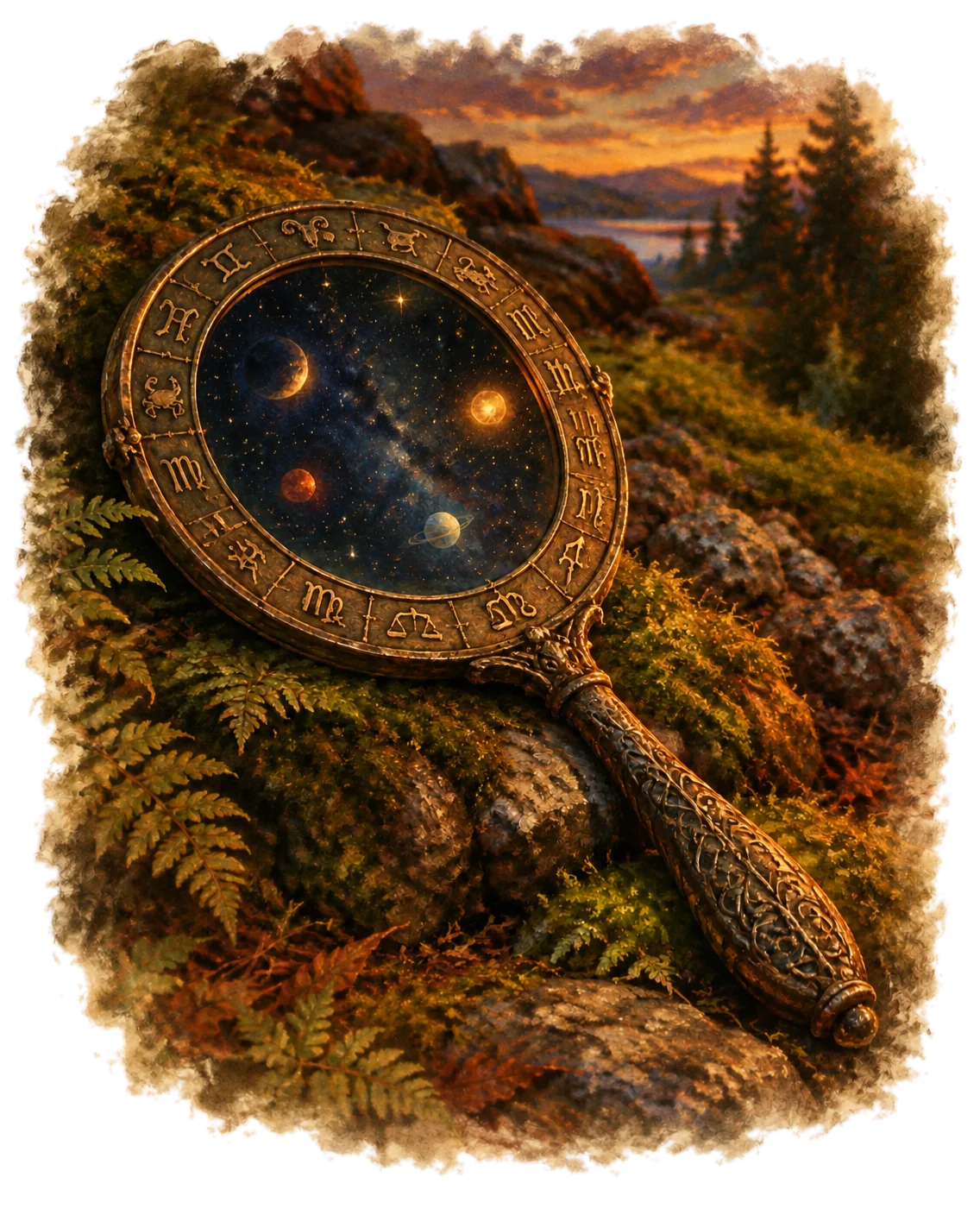
Carl Jung, the psychiatrist who gave us the language of archetypes, took this seriously. In 1947 he wrote to the Indian astrologer B. V. Raman: “In cases of difficult psychological diagnosis I usually get a horoscope in order to have a further point of view from an entirely different angle.” Archetypal psychology, from Jung to James Hillman, treats the great figures of myth as patterns alive in every psyche. The planets are some of the oldest of those figures.
The planets as parts of you
My own model, Internal Family Solar Systems (IFSS), builds on Richard Schwartz’s Internal Family Systems. IFS sees each of us as a family of parts, with a Self underneath that is calm, curious and kind. In 2015 it was listed as an evidence-based practice in SAMHSA’s National Registry of Evidence-based Programs and Practices, and therapists around the world use it. Vedic astrology says something similar in another language: everyone has every planet, and each one carries an archetype.
The Sanskrit word for planet, graha, means “seizer”: whatever grabs hold of you. When Mars seizes you, the whole world looks like a fight. Speaking for the part (“a part of me is furious”) instead of from it (“I am furious”) gives you room to breathe. IFS calls that unblending. The chart gives each part a face, a story and a myth to live in. In the Maps, each one is drawn as a landmark on the coast of your own map.
- Sun
The Sovereign

The part that rules itself first, and trusts itself to make a way forward.
On your map: a beacon, where you shine and are seen.
- Moon
The Healer
The part that feels, and looks for what is hurting and how it can mend.
On your map: a well, where you draw comfort and feeling.
- Mars
The Warrior
The part that protects, quick and red, because life needs defending before anything else.
On your map: a watchtower, where you stand guard and act.
- Mercury
The Apprentice
The youngest at court, carrying messages and asking a thousand questions.
On your map: a signpost, where you learn, choose and speak.
- Jupiter
The Sage

The teacher. Mercury gathers the facts, and Jupiter tells you what they add up to.
On your map: a temple, where you find meaning and teachers.
- Venus
The Lover
The part that works with desire instead of against it. Creativity is love making something.
On your map: a rose arbor, where you find beauty and love.
- Saturn
The Steward
The keeper of the hall, who brings order slowly and doesn’t need the credit.
On your map: standing stones, where you build slowly, and last.
- Rahu
The Seeker

A head with no body, forever reaching for the new and the unknown.
On your map: a ship, where you reach for the new.
- Ketu
The Mystic

A body with no head, forever letting go of what no longer matters.
On your map: a hermit’s hut, where you already know, and let go.
The methods underneath
I’m not a psychotherapist, and this isn’t therapy. It’s self-inquiry and spiritual guidance. But the tools are borrowed with care from ones that therapists and psychologists use, and I name where each comes from.
- Parts work, IFS-informed.
I trained with the IFS Institute’s online circle in 2020. I credit Schwartz’s model by name, and IFSS isn’t affiliated with or endorsed by the IFS Institute.
- Projection.
The chart is used the way an open image is used in psychology: what you notice, and how you react, is the material.
- Archetypes and myth.
Jung’s archetypes and the old stories of each planet, so a part has a myth to live in and a way through.
- Trauma-informed care.
No bad parts. Steadying comes before depth, everything is an invitation, and the tender work IFS does with exiles belongs with a trained, licensed guide.
From my own chart
This is how I use my own chart to understand myself. Four planets do most of the talking.
Jupiter and Mercury share my 10th house, the house of work in the world. The Sage (Jupiter) is the part of me that teaches and guides, and the Apprentice (Mercury) is the part that never stops asking questions. My work is at its best when both are in the room: learning out loud, and translating something strange into something useful.
Venus rules my rising sign and sits in Pisces, the sign where Venus is strongest. The Lover in me (Venus) wants everything to be beautiful, and perfect before anyone sees it. That part gives my work its care and its finish. Left in charge, it would polish forever and ship nothing.
Saturn holds the reins. Jupiter and Mercury live in Saturn’s sign, Aquarius, so the Steward sets the terms for how my teacher and my talker speak: it keeps me focused, in my lane, and from saying three things when one will do (which I often still do). Saturn also casts its gaze on my rising sign, the way I meet the world. There it slows me down and makes me careful about being seen, sometimes more careful than the work needs.
None of these is a good part or a bad one. Knowing them by name lets me notice which one is driving, and ask the others what they need.
Astrotensegrity: the physics underneath
Skeptics ask how planets millions of kilometres away could have anything to do with us. My answer is a theory I call astrotensegrity, a word I coined in my 2026 dissertation. Here it is in five steps.
- 1
Wholes held by tension
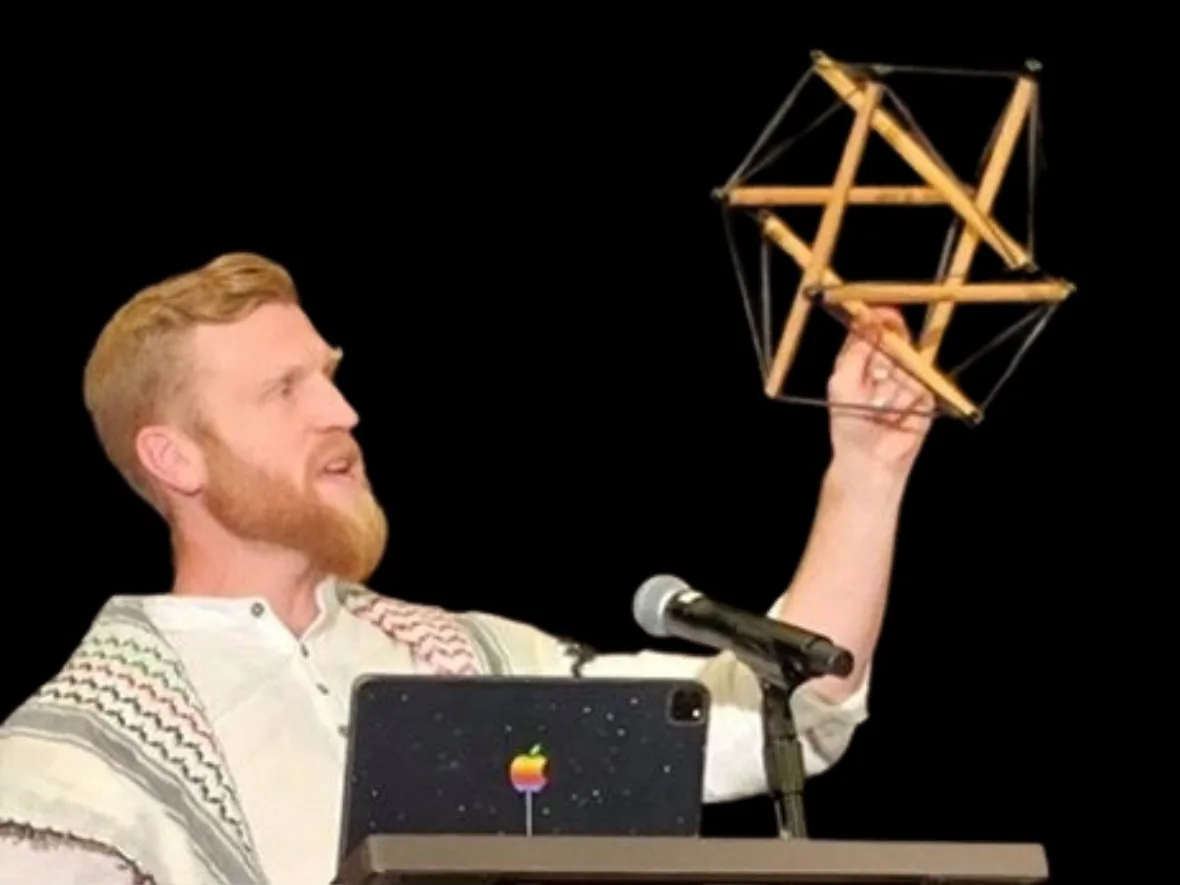
Buckminster Fuller named it tensegrity: tension plus integrity. A tensegrity structure is islands of compression floating in a sea of tension, so a change in any one part reshapes the whole.
- 2
Living bodies are built this way
The surgeon Stephen Levin called it biotensegrity. The cell biologist Donald Ingber found it inside living cells, where a change in a cell’s shape changes what the cell does.
- 3
So is the solar system
Fuller pictured the planets as “spherical islands” held together “only by Kepler’s and Newton’s invisible tension: gravity” (Synergetics, 792.51). Kepler found its math in a book about cosmic harmony: his third law, which ties each planet’s year to its distance from the Sun, appeared in Harmonices Mundi in 1619.
- 4
Space itself ripples
Einstein’s general relativity says spacetime has physical properties and carries gravitational waves. LIGO first measured them in 2015, and the Nobel Prize followed in 2017. Every orbiting mass sends out a wake, the way a boat does on a still lake.
- 5
Angles make patterns
When two waves meet, their timing decides whether they add up or cancel out. That’s interference, the effect LIGO’s lasers use to catch a gravitational wave, and the effect that draws cymatic patterns in sand on a singing Chladni plate. Astrology’s aspects are angles: an opposition halves the circle, a trine cuts it in thirds. In this theory, the aspects describe interference patterns, and Jyotish is the ancient practice of reading them as they reach bodies and minds that are tensegrity structures too.
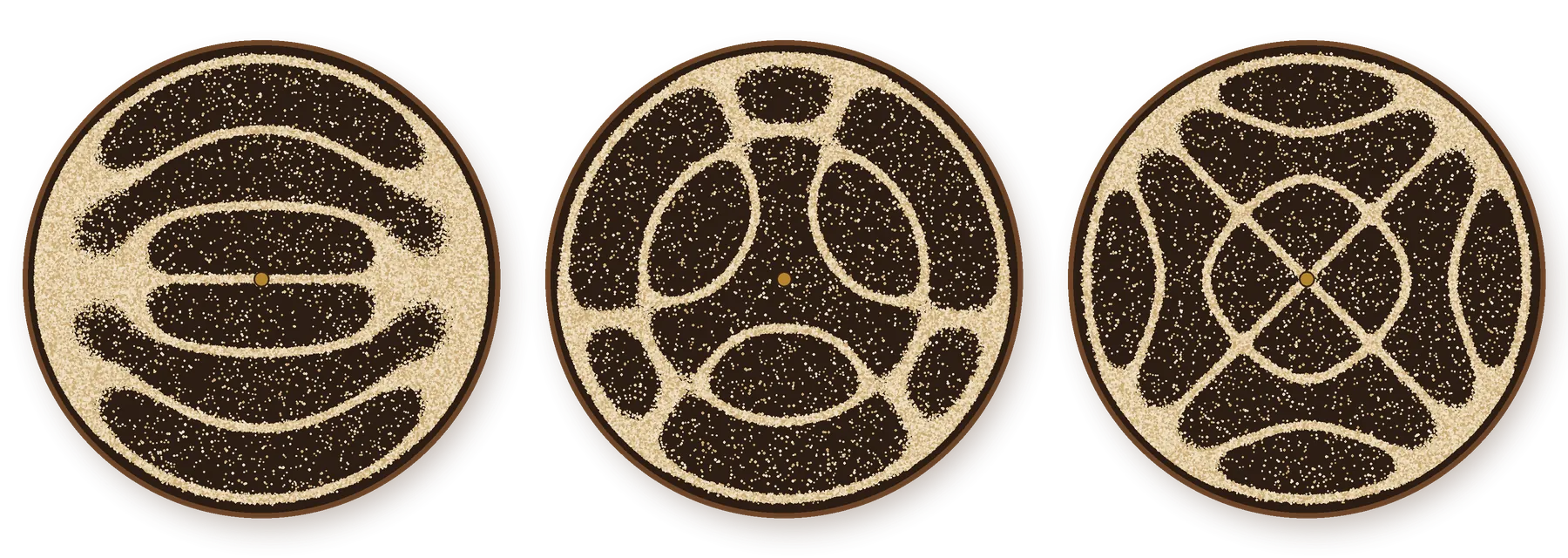
It opens research questions I love: how living tension structures respond to patterned fields, and how the classical measures of Jyotish could be tested against them. For the long version:
- Multi Dimensional Essentials, my two-day masterclass on the geometry of space, tensegrity and cymatics, free in the Common Knowledge library.
- Astro 101, which teaches how astrology works, physically and metaphysically, and how to start reading your own chart.
- Two chapters of my dissertation on Substack: the architecture of life and astrotensegrity as the map of your internal planets.
Where you’ll meet it at Ecotone
- Your planetary chapter.
Add your birth details to the free Assessment to see the chapter you’re living in. What a chapter is.
- Good Times.
A free calculator that reads the Vedic almanac for good days and hours, translated for everyday plans.
- Your personal book.
The Genius Map reads your chart beside your own answers and questions, in plain words.
- PHASE SHIFT.
Letters on Substack that follow the Moon’s rhythm.
- Free live classes.
On the first Wednesday of each month, and when the sky turns: a change of the nodes, an eclipse. See what’s coming.
Questions people ask
Do I need to believe in astrology?
No belief needed, only curiosity. Treat your chart like a mirror: notice what you recognize, what you resist and what surprises you. All three tell you something about the parts of you doing the looking.
Is astrology a forecast?
Yes, the way a weather forecast is. It reads the conditions ahead, not your fate. The months ahead are read as windows, never promises, and what you do with the weather is up to you.
Is this therapy?
No. I’m not a psychotherapist. IFSS is self-inquiry and spiritual guidance, IFS-informed and built on trauma-informed care. It can sit beside therapy, and it never replaces care from a licensed professional.
Why Vedic astrology?
Vedic astrology, or Jyotish, measures the zodiac against the stars, reads the Moon first, and adds a personal clock of planetary chapters called dashas. That clock is what makes it so useful in a transition: it tells you what season you are in.
What is astrotensegrity?
My theory of how astrology works physically. The solar system is a tensegrity structure held together by gravity, each planet’s wake meets the others at Earth as an interference pattern, and astrology’s aspects describe those patterns as they reach bodies and minds that are tensegrity structures too. I coined the word in my 2026 dissertation, Internal Family Solar Systems.
Where do I start?
With the free Ecotone Assessment. Add your birth details at the end to see your planetary chapter. When you want to read your own chart, Astro 101 teaches the essentials, both physically and metaphysically.
The astrology here comes from the Vedic tradition as I learned it from my Jyotish teachers: Sam Geppi, Komilla Sutton, Simon Chokoisky and Freedom Cole. Internal Family Systems is Richard Schwartz’s model, and IFSS is my extension of it.
Keep exploring
- Your planetary chapter: what a dasha is, and the nine chapters of a life.
- What is an ecotone? The idea behind the whole school.
- Internal Family Solar Systems: the planets as parts of you, in full.